The new year found me doing photography even before it was a minute old. Having placed myself on a hill overlooking London, I was in a perfect position to capture the large number of new year fireworks displays being held across a fifty square mile area- indeed, it seemed as though the whole city was one big explosion of light, colour, and sound. As well as being a wonderful spectacle, it was a fast-paced learning environment of capturing the fireworks at their peak, something notoriously hard to do without burst shooting. As that’s something which I haven’t quite figured out yet, I was left without an easy option.


Above left: The sky really was alive with explosions. This was taken at 00:04. 8/5s, f/8, ISO 3200. Above right: Even at 00:13, the fireworks were still going strong. I particularly like the silhouette effect seen on the right of this image, and prefer the darker sky here to the very light colour of the first image. 1/2s, f/8, ISO 3200.
My theory for this shoot was to use a medium-short exposure time to capture the fireworks at their peak and some light trails besides to really enhance the effect, but also to let enough light get to the sensor to provide at least a shadow of a background. On a number of occasions, just when I thought I had the balance between these factors figured out, I then zoomed in or out, and the mental calculations began again. The longer the zoom on zoomable lenses, the higher the lowest possible f value is, and this can really affect the way the light balance occurs and how the photo pans out.
My favourite example of this all coming together successfully was this well-timed shot of a display on a neighbouring hill (right). Not only are there the light trails of the fireworks going up, but plenty of the bursts of the explosions, and the light from those two has highlighted the smoke at ground level. Zooming in, the silhouettes of figures are visible at the base of the fireworks, and the cherry on the top is the further fireworks in the background- and the lack of blur. 1/2s, f/8, ISO 3200.


However, blur is not always a disadvantage, only when it concerns the photograph’s subject. The photo on the left is a miracle that I can’t explain: the background lights are blurred, creating quite a pleasing movement effect, but the firework I was focussing on is somehow not blurred at all. In fact, it is very detailed, with not only the initial rocket trail, but the subsequent explosion and sparkle trails. The red and green line on the left of the sky is presumed to be a drone. 1/2s, f/8, ISO 3200.
This outing was not only a lesson but a celebration of the new year, and though I used the perfectly-presented opportunity to learn more about firework photography, I also spent a lot of the time just watching and appreciating the displays. To see the fireworks up close through my lens was a particular treat, and to get some good pictures a real bonus.
My time at North Weald this month was spread over a few visits, one of which was an organised fly in. Although I arrived a little too late to catch the arrivals, and felt simply too cold to stay for departures, the visiting and live-in aircraft which were parked up still offered some good subjects, as well as casual passers by like Westland Gazelle G-CBKD (below left). The Yak-52 trainer aircraft and its stilt-like undercarriage (below right) was one of the highlights for me, as I usually only glimpse it when hidden away under covers on the other side of the fence a little further towards the runway.


There were also a number of classic cars in attendance, mixed in with the usual modern vehicles in the main car park. This made taking good pictures of them quite a challenge, and involved some waiting about for the cars beside them to leave or move out of the best shot, but my patience paid off with some quite good results. My two favourites were a Jaguar (below left) and a Zodiac (below right), and this pair of photos ended up being what I consider as my best work from the fly in. Oh well.


There were also a number of encounters with more ‘normal’ aircraft throughout the month, including Westland Wasp G-RIMM (below left, at the back) and Westland Scout G-CRUM (below left). The Wasp being the Naval version of the Scout, it was great to be able to get both of them in one shot, even if the weather did slightly let me down for a good background. On another day, I was particularly interested to have a first encounter with the yellow Folland Gnat G-MOUR (below right), which I had not previously known was based at North Weald. The balanced lighting of this shot was mainly achieved in post-production, as the bright paint of the aircraft and the glare of the overcast sky combined to threaten overexposure, but a little use of the contrast wheel at the time and mixing of the levels when editing made it turn out alright in the end. I even caught the front-seat pilot leaning forwards to give me a hard stare.


As is becoming customary for the beginning of the year, I paid a visit to Duxford for a day, updating my knowledge of what lives there and in particular visiting the exhibition on photo reconnaissance. I went up on a weekend, so there there was very little flying going on, and then only light general aircraft which were not of interest. In truth, I had no great photographic ambitions for this trip, but as I’m hardly likely to visit an airfield without my camera, a few photos did end up getting taken.
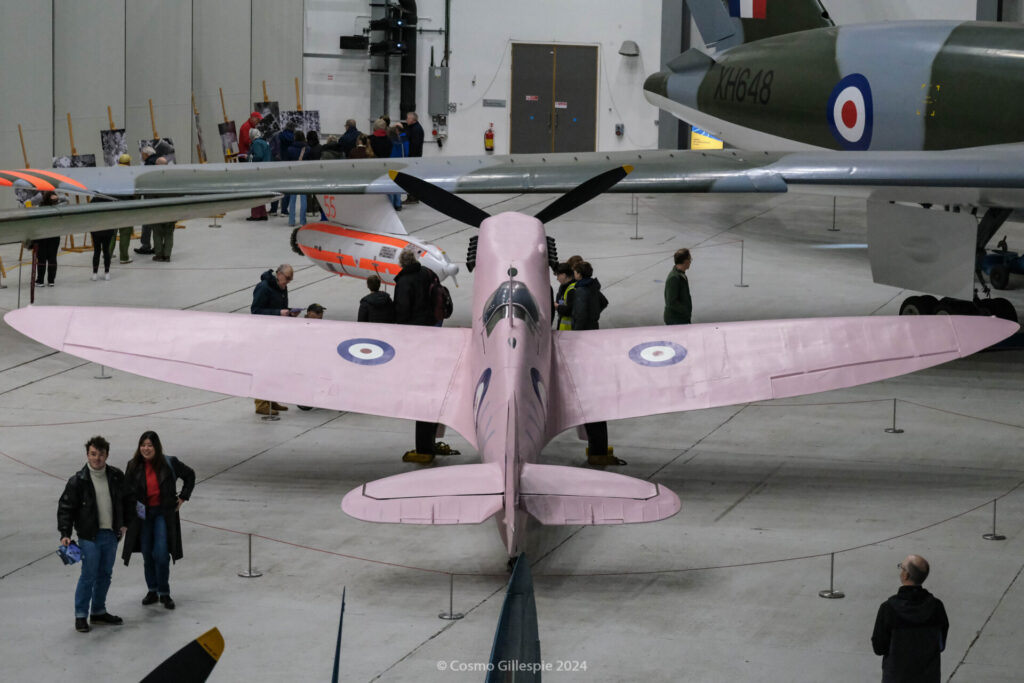
The photo reconnaissance exhibition featured a number of real aircraft rather than information boards, including a Lysander, a Victor, and a Spitfire normally resident at North Weald. There was also a much talked-about pink Spitfire (left), a livery which was designed to reduce the aircraft’s visibility when flying at dawn and dusk. I don’t generally go in for photographing aircraft in museums, but some exceptions were made in this case, even if it was from above.
One of the best parts about visiting Duxford is the amount of working airframes they have in the hangars. It is quite impressive for any museum to say that a good portion of their exhibits are in full working order, and particularly an air museum!
One of the live aircraft hangars had some particularly moody lighting, which served to pick out the shadows and highlights on the masses of serviceable heritage aircraft which were being stored there over the winter- Mustangs, Spitfires, and a Sea Fury among them. The shot to the right was taken through the stand of a Blenheim cockpit, with myself crouching down and leaning under the barrier. I think that it was well worth it!
This was a very relaxed visit, so I am happy to have even this pair of photos to show for it.


This was a quiet month for photography, between work and bad weather, and there is only really one extra photo (left). Even that was taken at the end of the fireworks session, but doesn’t quite belong with it, as there are no fireworks and it was intended to merely be a skyline shot.
I did, though, spend quite a while taking pictures for the article about My Kit, and those will be featured in an article later this year about approaching product photography.