With clear skies prevailing, this month was opened by some additions to my Constellation Collection. When I started this project, I was just too late in the year to get some of my favourite constellations, which are most easily visible in the mid-evening of the late winter months. However, on one night in the middle of February, I was able to photograph in full six constellations which had not previously been accounted for in this project across just three photos. One of those (right) has the complete constellations of Orion and Taurus, as well as the star cluster of the Pleiades, all in one picture.
Canis Minor, Leo, Lepus, and Sextans were also captured, bringing my overall count of constellations being ‘partially’ represented in the project by one or more constellation star to 47. With only 89 in total (counting Serpens as two, Serpens Caput and Serpens Cauda), I’m over half way!


All three of these pictures were taken using a three-second exposure at f/2.8 and ISO 1000. These settings achieve the balance of a colourful sky and some foreground shadows, rather than just a plain black sheet, whilst also avoiding star trails. I have also found that whilst having sharp focus on the stars might seem desirable, missing the focus point a little makes the dots a little bigger, and easier to see, whilst having very little impact on the overall image. As long as any foreground is sharp, nobody really notices.
The red line below the ‘Hydra (Partial)’ label in the image on the right above was made by an aircraft that got caught in the long exposure. Another shot I took that night captures what looks like a string of Christmas lights, but is in fact a lower-flying commercial aircraft.

Feeling confident, and as the night was warm, I also attempted some close-ups of Orion’s Nebula, the Hyades, and the Pleiades. These images ended up being more ‘scientific’ than ‘aesthetic’, and I have yet to be able to capture the coloured gas clouds which I know to surround all three of these star clusters, but they are still fairly sharp, which is impressive for the focal length and shutter speed. Left: Orion’s Nebula. 2s, f/6.7, ISO 5000.
The easiest of the three to spot is Orion’s Nebula (above), as they form the ‘sword’ of the constellation when it is viewed with the naked eye. The Hyades, however, is a more open and less obvious cluster, as you can see from the picture on the right. There is no clear shape as in the other two clusters, and the principle stars are hard to spot without aids. It can be found by locating Aldebaran, as though this is not part of the cluster, the stars below and right of that are. Right: The Hyades. 3s, f/6.4, ISO 5000.


Lastly, the Pleiades are an easy spot. Also known as the Seven Sisters, as there are seven major stars in the cluster, it is very bright and easily visible without a telescope or binoculars. This is a cluster which is most frequently photographed surrounded by clouds of blue gas, something which I aspire to do myself. However, I think that until my budget increases significantly, that will remain a dream. Left: The Pleiades. 2s, f/6.7, ISO 5000.
One of my weekends was spent on two visits to the Imperial War Museum, London. The first was with the sole intention of visiting the exhibitions and, of course, the gift shop, but the return the next day was to better appreciate the exterior of the building. Set in almost fifteen acres of public park, including sports pitches, a Tibetan Peace Garden, and the iconic pair of naval guns right outside the front doors, the museum is a visual gem in the middle of otherwise dull London streets, and offers a number of good photographs without very much effort.
However, I was distracted from my target as soon as I entered the park. Beneath the leafless plain trees and bathed in warm sunlight was a veritable carpet of fully-flowering daffodils and crocuses. I wasn’t alone in their pursuit, with at least two other photographers joining me whilst I was there, and I could tell that we were all working not to get in each other’s shots. We were mostly successful, and I was very happy with the flower shots I walked away with- nothing particularly stunning, but well composed and with plenty of colour, and few distractions in the background.


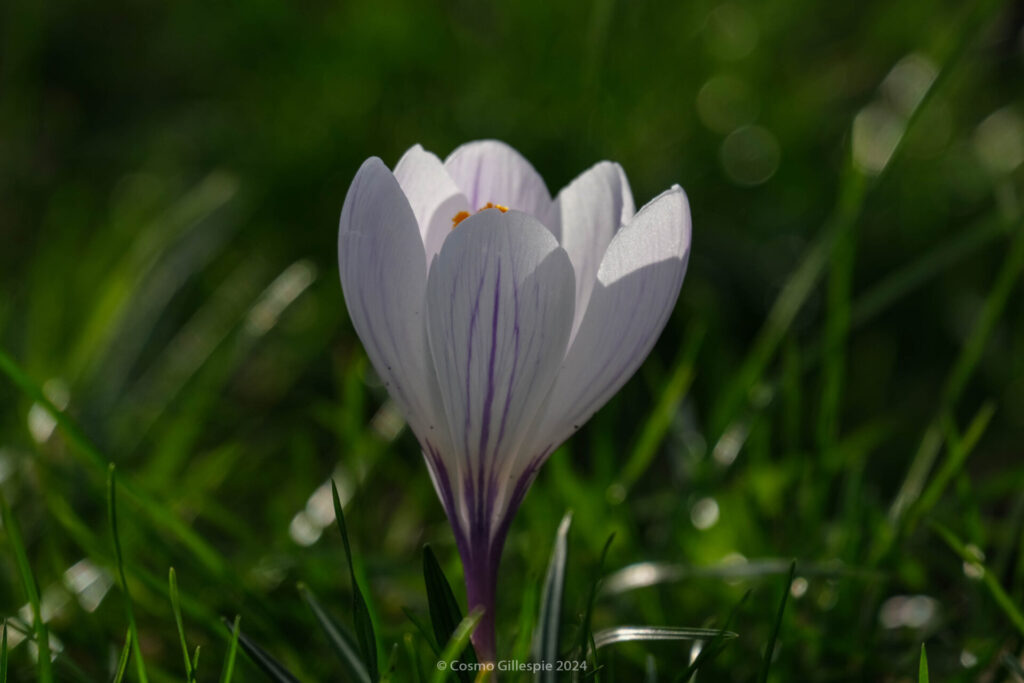
Above left: Purple crocuses, with the tip of the stamen framed perfectly between the two rear petals which appear either side. 1/320s, f/6.7, ISO 400. Above middle: A daffodil in a sea of the same. I deliberately placed one standalone flower head against the background of similar colours to give a background that is bright and thematic but not too distracting. 1/640s, f/6.7, ISO 320. Above right: Another crocus, this time more in shadow. I was attempting a backlighting effect which I have been successful with before, but it didn’t quite work out. 1/320s, f/6.7, ISO 200.
I did try to photograph some of the abundant pink blossoms in the Tibetan Peace Garden, but they were too close for my long lens. As you can see from the image on the right, some of it does make it into focus- but there are notable parts which are blurred. Sadly, all of my attempts ended like this, blurred in one part or another. Not wanting to stop for a lens change, I moved on.


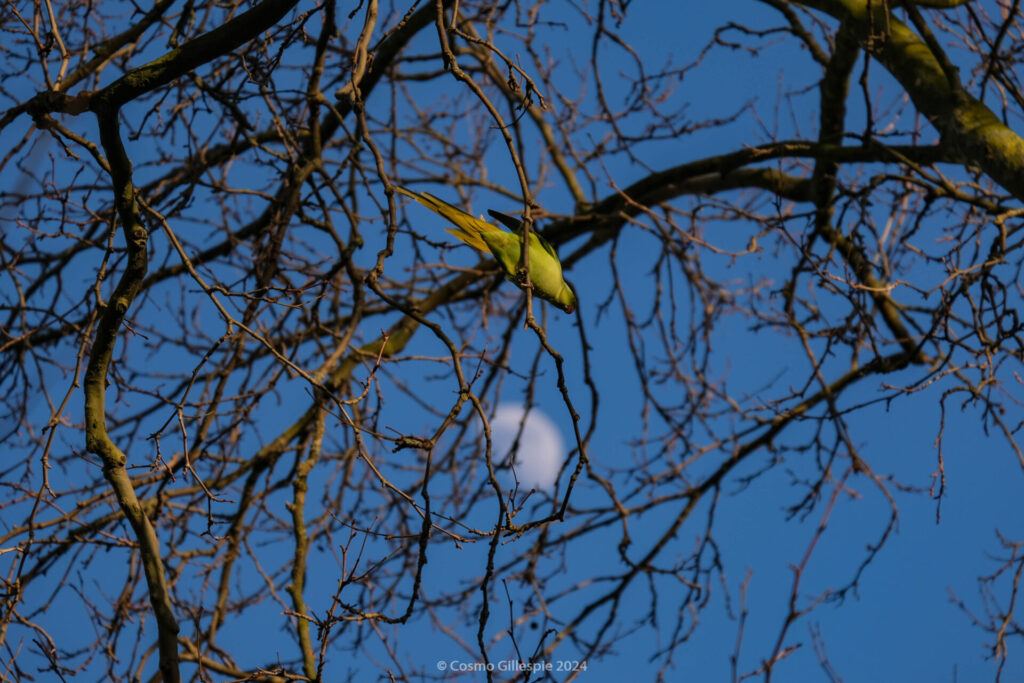
As well as the flowers, I also saw a great deal of the park’s wildlife- aside, of course, from the people. Grey squirrels (left) and rooks (below left; middle) are both fairly routine for London, but I wasn’t expecting the parakeet (below right)! I also heard what I believe was a woodpecker, but despite craning my neck into a group of trees for almost twenty minutes, it eluded me. It was during that time that I got the two shots below, making use of the early sunset light and a handy momentary conjunction with the moon.

The gardens had been more than ample material for a day’s photography practice, but I still hadn’t done very much with the façade which had been the main attraction in the first place. There just wasn’t a particularly unique angle to work with- until, as I reached the main gate onto Lambeth Road to leave, something very ordinary caught my eye. From a suitably low angle, and with the right timing, the museum was reflected beautifully in a glassy puddle, creating some very atmospheric compositions. I have wanted an opportunity to do something like this for a long time, and this was the perfect location!

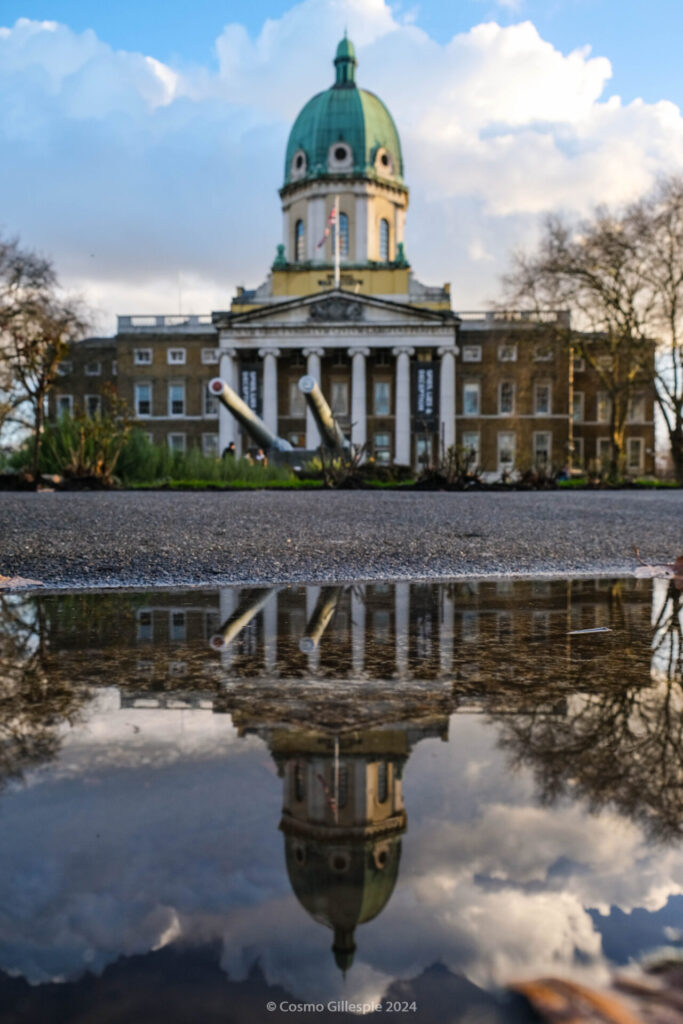
The image on the left above was the one I was happiest with in the end, as the museum itself is in focus rather than the reflection as in the second picture. However, I think that the picture on the right has slightly better framing- you can see more of the guns in the water, and the small amount of leaf in the bottom right is a hinting reminder that this was taken in a puddle reflection. It’s a shame that the focus point on the museum was missed, but I’ll just call it artistic.
From my experiences over that weekend, I can say that IWM London is a great day out, with lots of interesting exhibitions and a few full-size aircraft, as well as photography opportunities in the grounds. Now that I have my ‘sunny day’ pictures, I’ll be back for more as soon as snow falls!
In an otherwise fairly quiet month, my highlight of February was a long weekend of skiing in Chamonix, France. With only four days to work with, I made the most of every opportunity I got for photography, beginning with snagging a spare window seat on the flight out to capture the views over the cloud tops and the arrival into Geneva. The landscapes I passed on the coach journey from the airport to the resort were also beautiful, starting with flat fields but quickly steepening into gorges and half-tunneled roads as we moved further into the Alps.
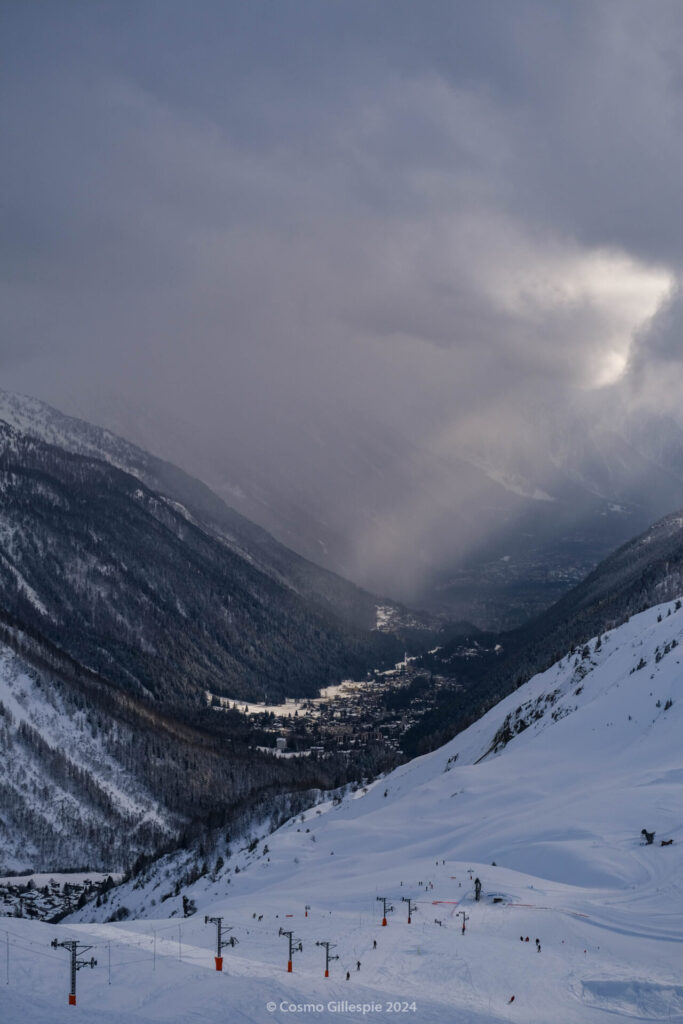
During the day, the views from both the valley floor and the slopes at 6,500 feet were beautiful. Looking down into the Chamonix valley with its carpet of buildings was something I could have done for hours, were it not for the call of the actual skiing that I was there to do. Being a confident skier, I carried my camera on all three skiing days, and used it more than I expected. I was lucky to have it when the view on the right presented itself, as my phone camera did not nearly do it justice. 1/100s, f/5.6, ISO 160. Contrast -1.

Of course, as someone who is not used to so much snow and mountainous terrain, I was in awe of almost every new view which was presented to me, even if I’d already seen it the day or hour before. A number of fairly generic photos were taken of mountains and forests, but my three favourites are below. Left: Some picture-postcard peaks and forest at the top of the Vallorcine télécabine. Middle: A more minimalist shot taking advantage of the colour contrast between foreground and background. Right: The dam at Vallorcine, as seen from part way down a blue run leading lower into the valley.


One of the things which impressed me the most about the area where I was staying was how bright the nights were. With the valley coated in fresh snowfall, and when the night was only half overcast, the moon was reflected to create practically daylight conditions on the valley floor, bright enough to cause shadows. Although it was literally midnight when I was outside to take my landscape shots, it looks like midday!


Above left: Were it not for the stars, this could have been mistaken for an oddly grainy daytime shot. I was lucky that the patchy sky cleared for long enough for me to take this picture- my other attempts at this angle had far too much cloud! 1s, f/2.8, ISO 8000. Above right: A more hidden viewpoint down into the valley. The light reflecting on the trees in the bottom right is the giveaway here. 1s, f/3.6, ISO 8000.
The difference which the ambient light level makes to an image is illustrated very well by the pair of photos below, taken from roughly the same place on the first (below left) and last (below right) nights of my stay. The settings are the same (1s, f/2.8, ISO 8000), but you wouldn’t know it from the pictures. With the more overcast sky on the right, and fog evidenced by the lack of visibility, the surrounding hills are much darker, and light pools on the snow more apparent. Not to mention that the cars seem to be in totally different positions.


In other night-time shots, I played into the darkness rather than the light, aiming to capture cabins such as those on the right exactly as I saw them. The warm glow of the windows was particularly important to my composition, so I had to be sure the exposure was balanced to get enough detail of the surroundings whilst not over exposing the lightest part of the image, potentially writing off the shot.


I also had a couple of moments of aviation interest, the first when the mountain rescue Airbus H-145 helicopter F-ZBQO flew briefly over the slopes. In a fine display of precision handling, the pilot flew below the level of the run I was at the edge of, hovered, kicking up a massive cloud of fine snow, then whizzed away over the mountains to the north. A very impressive if somewhat sobering encounter.
The second encounter was with a paraglider soaring quite low above the town of Chamonix itself, which seemed quite adventurous given the steep and wooded sides of the valley. These were a common sight, as paragliding experiences are offered for sale, and they were nice to see occasionally, floating above the towns, villages, and their outlying areas.


On my final morning, as I began to travel back to the airport, the various breaks in my journey gave me some nice views of the more domestic side of the valley and its long-term inhabitants. Left, top: The main street of Montroc, looking east from the bus stop. Left, bottom: A driveway after overnight snowfall leading the eye into the forest. Below: This mail box continues to be buried by heavily-falling snow.

This long weekend was definitely my highlight of the year so far, with lots of good skiing on fresh snow and challenging but beautiful runs, accompanied by a number of excellent photography opportunities. After a while of saving up, I would definitely be interested in going there again!
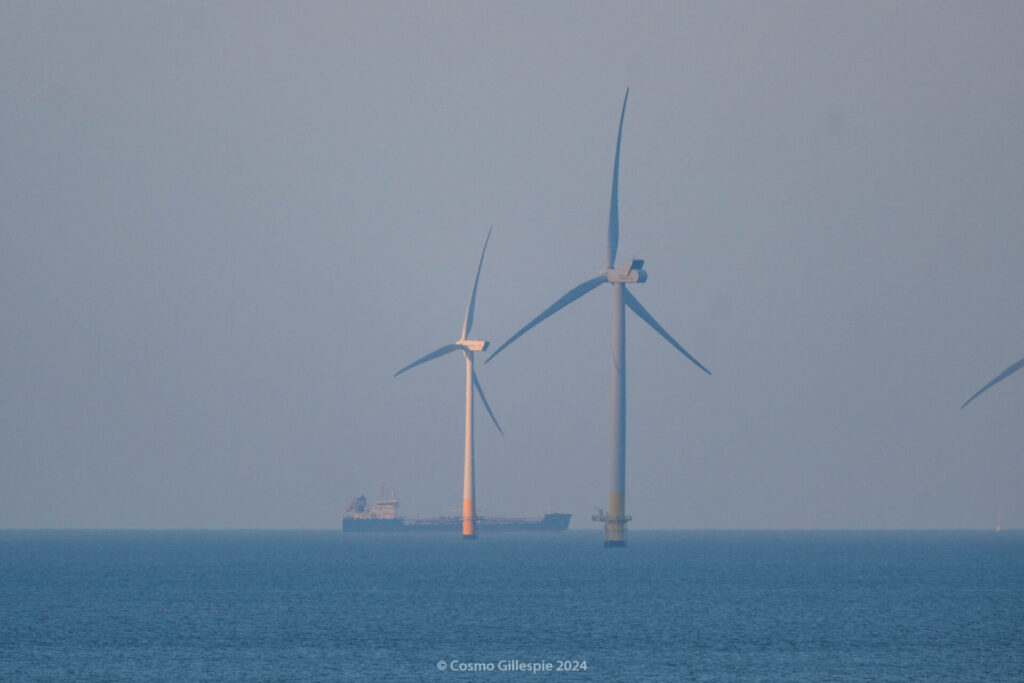
The pair of extra images this month are from two very different sources. The image to the right was taken looking north from Whistable, catching some of the shipping behind the wind turbines to create a typical modern seascape. My only gripe with this shot is the additional blade peaking in on the right, though this was lost in the square crop when I shared it to Instagram. This was mainly a test-shot for a new lens which I got, after a long time of wanting it, and which will be discussed in greater detail later this year. The second photo is of another air ambulance encounter- two in one month!- though this one of a more mundane kind. G-HHEM of the Essex & Herts Air Ambulance is not an unknown sight over my area, but to see it this low was a great opportunity for a more detailed photo than that of a pinprick in the distance.