Once again, quite a bit of time was spent at North Weald this month, yielding some very good results. In one case, I finally made a breakthrough which I’ve been working towards for a while- I finally caught a whole prop-disc! Although it was actually a tail-rotor disc on Westland Wasp G-RIMM, the effect and achievement are the same to my mind.
This first photo is the one which made me think that this was the time to try playing around with my settings. It was taken using the automatic settings, but I could see the tantalising bow-tie of the tail rotor, and knew that I wasn’t far off. 1/250s, f/6, ISO 160.

The solution lay in the direction of a slower shutter speed, but not too much slower as it was still full daylight, and I didn’t want to overexpose the picture. The move to manual settings has, as you may see, taken away a lot of the natural vibrancy of the image, and this is after extensive recovery in editing, but the tie is getting bigger. 1/125s, f/11, ISO 320.

My first success! Seeing that whole disc on my little LCD screen made me smile like crazy. The colours in this photo are even more strange as the true colour of the helicopter had somehow been lost, but I managed to save it to a reasonable level, I think. I was so proud of this that I even gave a print of it to the Wasp’s pilot, who liked it a lot. 1/60s, f/16, ISO 320.

Although I made the main achievement of the full-circle, this came with some drawbacks. The ISO setting means that the images are grainier than usual, and the colours are also very diminished and had to be edited back in during post-processing. However, with the new technique under my belt, I now have a baseline to improve from. To start that process, I practiced by applying it to some other aircraft which I saw. Long may it continue!
Below left: Westland Lynx G-NCKS performing some engine ground-runs. 1/60s, f/20, ISO 320. Below right: Robinson Raven G-GOES shortly after take-off; also visible in the background of the Lynx picture. 1/60s, f/11, ISO 320.


There was also a sunset visit from a Westland-Bell Sioux, appropriately registered as G-MASH. I didn’t have the best angles for capturing this, but managed a couple of good shots nonetheless. As the helicopter is painted a dark colour, it appears pretty much as a silhouette against the colours of the sky and the clouds, which make up half of the photo’s appeal.


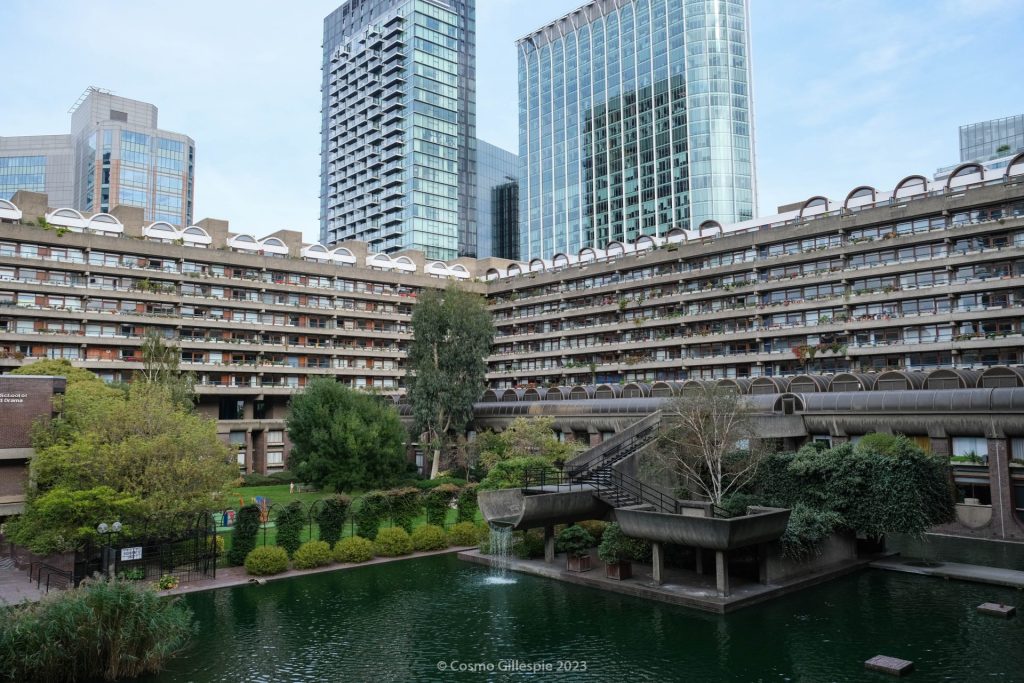
During an unexpected stopover in London, I had a chance to visit the Barbican, a miniature city of Brutalist design. As I had the advantage of previous acquaintance with the area behind me, I was able to spend my limited time in places where I knew there would be good opportunities for photography, those being the walkways over and around the main lake, which take in the Water Gardens, Lakeside Terrace, and surrounding buildings. With autumn coming on, the plants escaping from the host of window boxes were a riot of colour, and the light was brilliant.

Landscape or portrait? For this shot of the far corner of the courtyard, it was hard to decide. Landscape gives more of the foreground, but cuts off the tall buildings which are growing behind it rather dramatically, and the buildings around the courtyard are very similar. Portrait gives more detail overall, but it feels like there is too large a contrast between the dark of the foreground and the light of the background. I did try to equalise this in post-processing, but couldn’t seem to get anywhere.
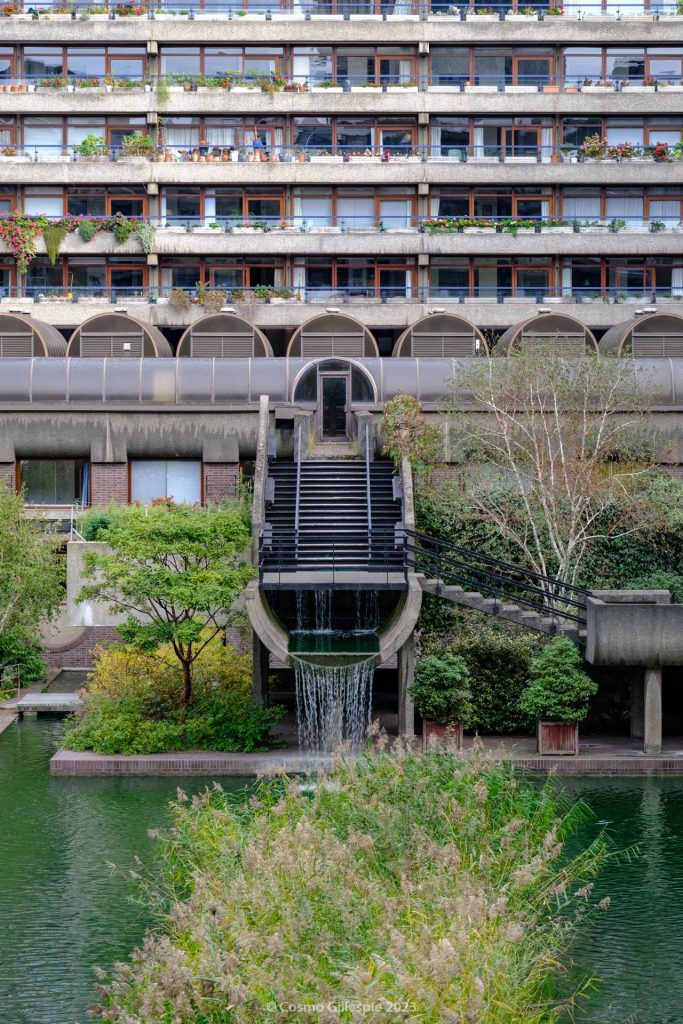
For some reason, most of my best photos from this outing are in portrait. To the right, I found that the staircase and waterfall made a very mice symmetrical shot, and one which particularly shows how the complex- which could simply appear as one large lump of brick and concrete, and in some places does- is broken up in this area by lots of trees, planting, and water. The same is shown in the picture below and left, a view of the Lakeside Terrace meeting the lake itself. For me, this shot is made by the people, and shows a snapshot of average life in this centre of the city. It was definitely worth taking the time to line this shot up, as the divide between the water and the built out piers creates a very nice centreline to the picture, almost a feature of its own. Below and right is a slightly softer vision, focusing on the autumnal colours of the trailing foliage and creating a contrast between the natural subject and the harsh buildings in the background.


I also took a few moments to apply my newfound understanding of shutter speeds to a small waterfall off a building on the east side of the lake, wondering where it would get me. Nowhere fantastic, for now, but it proves a point that I can take photos with longer exposures in daylight- and without a tripod. My next step would have been to introduce an ND filter, if I had had time.


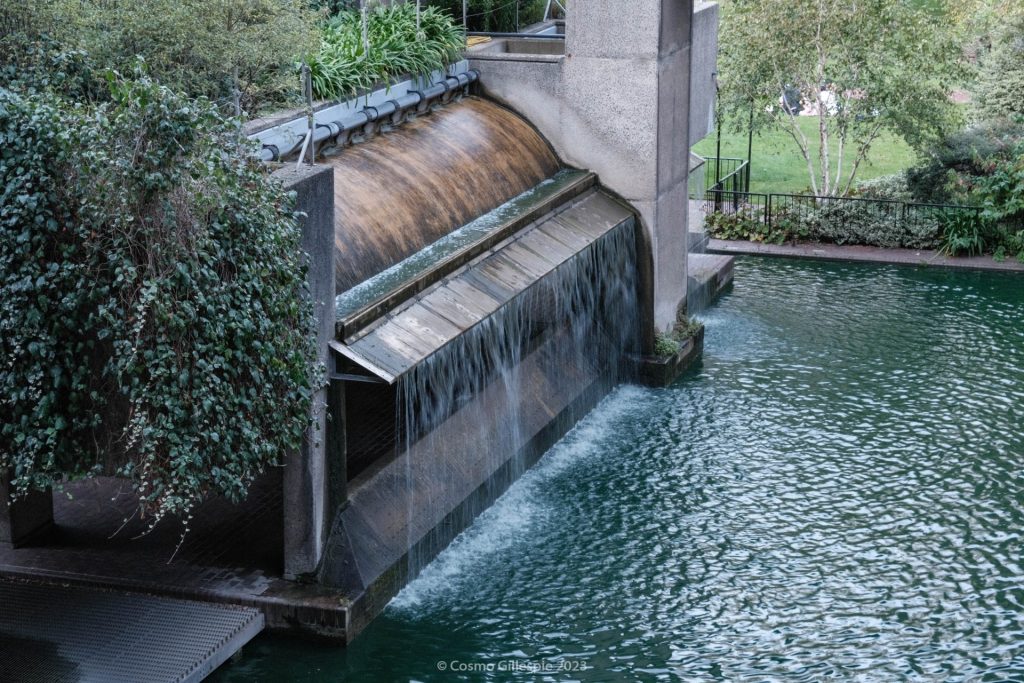
Above left: Base manual settings, with the water frozen in place. Not bad, but fairly average. 1/200s, f/4.5, ISO 320. Above middle: A slower shutter speed- the one needed to get the full disk on the Wasp tail rotor, in fact- gives us a little more smoothness, but retains some of the sharpness. The appearance is more of camera blur than a deliberate choice. 1/60s, f/5.6, ISO 320. Above right: It’s beginning to take on that ‘smooth’ waterfall effect, but also beginning to overexpose slightly in places. 1/15s, f/11, ISO 320.
Extras this month are not plentiful, but there are a couple. The first (below, left) is from a visit to Cambridge, where I was gifted a pale sunrise behind the lantern of the Stevenson Building, part of Christ’s College. The second (below, right) was taken at the Vulcan Restoration Trust’s hangar dance, a brilliant evening which saw the aircraft lit up very atmospherically, as well as displaying her own anti-collision lights. This view looking up from beneath the port wingtip shows just how big the aircraft is compared with people.


Also, a quick point on framing. Of the two images below, which is more interesting? Of course, this could vary with taste, but I would think that most would say the image on the right. The major difference doesn’t come from editing, just a slightly different viewpoint; you can see some of the tree on the far right of the left-hand image. It’s interesting to see what difference a few centimetres and a couple of seconds thought can make.

